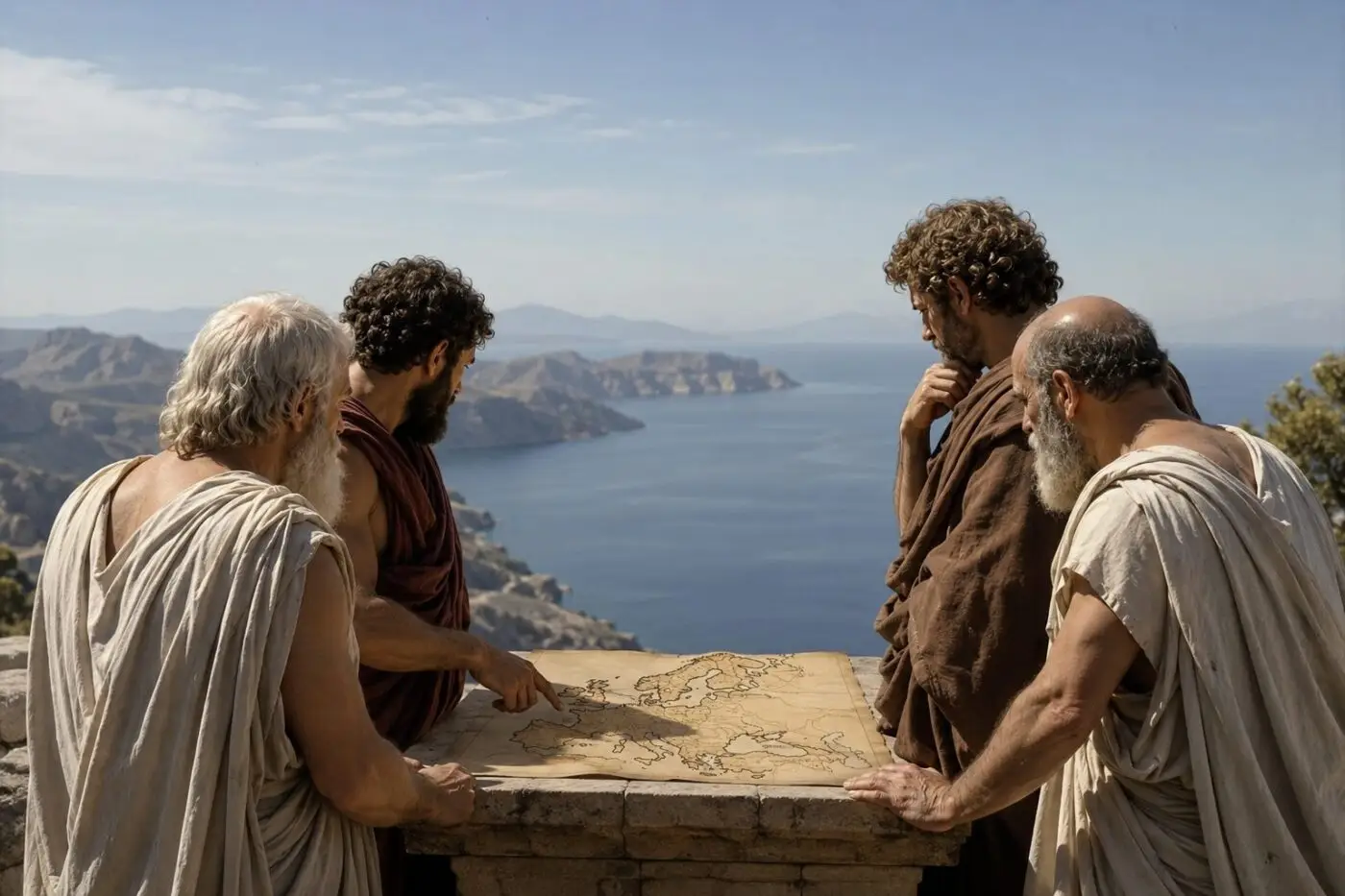
Ancient Greek thinkers viewed political order as a recurring cycle, while modern societies often imagine history moving steadily forward.
Modern societies often understand history as a largely linear process. Over time, elections become more inclusive, individual rights expand and political institutions grow stronger. From this perspective, even major crises are treated as temporary setbacks rather than signs that progress could be reversed.
Ancient Greek political thought offered a less reassuring view. Several Greek thinkers understood political time as cyclical, which is opposite of how most people today see time as. Governments rose, became corrupted and gave way to new systems that eventually suffered the same fate.
Plato, Aristotle and Polybius all examined how political systems decline, although they did not share one theory of historical time. Plato described one regime deteriorating into another, while Aristotle studied the causes of constitutional change. Polybius developed the clearest cyclical model, arguing that governments repeatedly rise, decay and eventually collapse.
From this perspective, democracies begin to decline when their institutions can no longer correct their own failures. Trust starts to fade, political divisions deepen, and leaders begin to see legal limits as barriers rather than protections.
The danger does not come from democracy alone. It comes from the belief that democratic progress cannot be reversed. This involves people losing faith, patriotism, meaning, and sense of what they are seeing.
Democracies repeat cycles of collapse
Polybius, a Greek historian, believed governments did follow a familiar pattern even as Plato did. A monarchy could become a tyranny. Rule by a respected elite could turn into rule by a corrupt few. Democracy could also break down if public anger, fear, and disorder became stronger than the institutions meant to contain them. At that point, people might once again turn to a powerful leader who promised stability.
As you can see yourself, this way of looking at history is very different from the idea that societies are always moving forward, and new fate is somehow defined.
We often assume that once a country gains free elections, stronger rights, or independent institutions, those achievements are secure and unique. History suggests otherwise. Institutions can weaken when people stop defending them or when leaders learn they can ignore the rules without consequences.
The Soviet Union was not a democracy, but its history shows how a system built around the promise of a new future can still fall into old habits. The revolution claimed to have broken with the past. Instead, power became concentrated, criticism became dangerous, and institutions existed mainly to protect those already in control.
By the final years of the Soviet Union, reform had become unavoidable. But reform also exposed how fragile the system was. The state struggled with economic stagnation, political rivalry, and a growing gap between official claims and everyday reality.
Versions of this pattern have appeared in many countries. New governments often come to power after war, revolution, or economic crisis. At first, they create rules meant to prevent the failures of the past. But as the years pass, those rules can become weaker.
That does not mean every country is trapped in an endless cycle. Decline can be stopped. But it requires institutions that can correct themselves, leaders who accept limits, and citizens who do not assume democracy will protect itself. It all hangs on strong leaders; that’s the moral of the story.
Having people of a democratic country electing wrong people for five times in a row will absolutely wreck the country to shreds. Anyway, the point is not that every democracy will collapse, but that repeating past mistakes from history will massively contribute to that.
The United States, for example, is often treated as if its democratic system is too established to fail. But no constitution can fully protect a country if voters repeatedly choose leaders who weaken institutions, reward loyalty over competence or treat political opponents as enemies of the state. One poor administration may be corrected. However, electing destructive people for the leaders of countries again and again can cause damage that lasts for decades.
Strong leadership matters because democratic systems still depend on people making difficult decisions at the right moment. Weak, reckless or self-serving leaders can accelerate problems that institutions are already struggling to contain. When that happens repeatedly, the state may continue to hold elections while becoming less stable, less capable and less democratic.
However, this widely impacts regular people too. There’s a rise in communism in the US and Europe, and many of these young people are completely lost in their idea of communism being beneficial. If we look at leading example of communism, Russia, we would find the system is centered on anything but the people.
Further, given the rise of internet, people who misunderstand history, can repeat their false ideas to larger groups of people, deceiving them as a result. Contributing to the already existing issue.

Anyways, the point is not that every democracy will collapse. It is that democracies can help create the conditions for their own decline by repeating mistakes that history has already defined…
-
 Why Democracies Repeat the Cycles That Bring Them Down
 -
 Ukraine Targets Critical Parts of Russian Oil Refineries
 -
 Used Electric Car Sales in Russia Rise Nearly 40% In 2026
 -
 Ukraine says drones hit Russian refineries and Wildberries site in Ryazan.
 -
 Russian Military Outlet Calls for Nationwide Air Defense Overhaul Amid Drone Threat